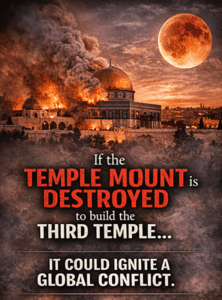
The Third Temple: History, Prophecy, and Why It Matters Today
Why the Temple Mount Is One of the Most Sensitive Places on Earth
The Temple Mount is not simply a historical location. It represents one of the most sacred areas in the world for multiple religions.
For Jews, the Temple Mount is the location where the First and Second Temples once stood. These temples were central to Jewish worship and national identity for centuries.
For Muslims, the site is home to the Al-Aqsa Mosque, considered the third-holiest site in Islam, as well as the Dome of the Rock.
Because of this shared significance, any change to the site has the potential to create religious and political tension across the region.
Introduction
The idea of a Third Temple in Jerusalem has been discussed for centuries in both Jewish and Christian traditions. Recent geopolitical tensions in the Middle East and renewed discussions about the Temple Mount have brought this topic back into public conversation.
Understanding what the Third Temple means requires looking at history, religion, and modern politics together.
Why the Third Temple Is Discussed Today
The idea of rebuilding a Third Temple comes from interpretations of biblical texts that refer to a temple existing in Jerusalem during future prophetic events.
Some interpreters point to passages found in:
These passages have led some believers to conclude that a future temple may one day be constructed in Jerusalem.
However, scholars and theologians interpret these passages differently. Some believe the references are symbolic, while others believe they describe a literal future temple.
Understanding the Importance of the Temple Mount
The Temple Mount is one of the most historically and religiously significant locations on Earth. Discussions about the possibility of a Third Temple are not only theological debates but also conversations about history, identity, and the future of Jerusalem.
Current Religious and Political Reality
Today the Temple Mount is administered by an Islamic religious authority known as the Waqf, while Israel maintains overall security control of the area.
Because of the extreme sensitivity surrounding the site, governments and religious leaders generally try to maintain the current status quo.
Even small incidents in the area have historically led to widespread protests or violence, demonstrating how emotionally and politically charged the location remains.
Why the Topic Continues to Draw Global Attention
The Temple Mount sits at the crossroads of history, faith, and modern geopolitics.
For some people, the site represents the fulfillment of ancient prophecies. For others, it represents an important cultural and religious heritage that must be protected.
Because of these deeply held beliefs, discussions surrounding the Third Temple continue to attract global attention and debate.
The First and Second Temples
The site known as the Temple Mount has long been the spiritual center of Jewish worship.
First Temple
The First Temple was built by Solomon around 960 BC.
It served as the central place of worship for the ancient kingdom of Israel.
In 586 BC, the Babylonian Empire destroyed the temple and Jerusalem.
Second Temple
After the Jewish people returned from exile, a new temple was built.
This temple was later expanded by Herod the Great.
In 70 AD the Roman Empire destroyed the Second Temple during the siege of Jerusalem.
Today, the Western Wall remains as part of the structure surrounding the ancient temple complex.
The Temple Mount Today
The Temple Mount remains one of the most sensitive religious sites in the world.
Two major Islamic holy structures stand on the site:
-
Al-Aqsa Mosque
-
Dome of the Rock
For Muslims, this area is the third holiest site in Islam.
For Jews, it is the location of the ancient temples described in the Bible.
Because of this shared significance, any discussion of rebuilding a temple carries major religious and political implications.
Modern Preparations
A small number of religious groups in Israel believe a Third Temple will eventually be built.
Some organizations have already prepared items traditionally used in temple worship, including priestly garments and ritual instruments.
However, rebuilding a temple would involve complex religious and political questions that remain unresolved.
Why the Topic Is So Sensitive
The Temple Mount sits at the intersection of faith, history, and geopolitics.
Any significant change to the status of the site could affect not only Israel and Palestine, but the broader Middle East and the world.
For this reason, discussions about the Third Temple are often approached with caution.
More on the Temple Mount
The First Temple (Solomon’s Temple)
The First Temple was built around 960 BC by Solomon in Jerusalem.
How It Was Destroyed
In 586 BC, the Babylonian Empire under King Nebuchadnezzar II conquered Jerusalem.
During the siege:
-
The city walls were broken.
-
The temple was looted of gold and sacred objects.
-
The temple building was burned to the ground.
Many people in Judah were taken into exile in Babylon. This event is known as the Babylonian Captivity.
🔨 Rebuilding After the First Temple
About 50 years later, the Achaemenid Empire conquered Babylon.
The Persian ruler Cyrus the Great allowed the Jewish people to return to Jerusalem.
What Happened When They Tried to Rebuild
The rebuilding faced several challenges:
• opposition from neighboring groups
• political pressure
• lack of resources
Construction eventually resumed under leaders such as Zerubbabel and the temple was completed around 516 BC.
This became known as the Second Temple.
🏛️ The Second Temple
The Second Temple stood for about 600 years.
Later it was greatly expanded by Herod the Great, creating a massive temple complex.
⚔️ How the Second Temple Was Destroyed
In 66–70 AD, a major Jewish revolt broke out against the Roman Empire.
Roman forces led by Titus besieged Jerusalem.
During the siege:
-
The city was surrounded for months.
-
Famine devastated the population.
-
The temple complex was eventually set on fire and destroyed in 70 AD.
According to historical accounts, the fire spread rapidly and consumed the structure.
Only parts of the outer retaining walls survived — including what is now called the Western Wall.
🔨 Attempts to Rebuild After the Second Temple
There were several attempts or discussions about rebuilding.
Roman Period Attempt (4th Century)
Roman Emperor Julian the Apostate reportedly supported rebuilding the temple around 363 AD.
However, the effort stopped suddenly, possibly due to:
-
earthquakes
-
fires during construction
-
political instability
The project was abandoned.
📜 After That
Since the destruction of the Second Temple:
-
Jewish worship adapted to synagogues and prayer instead of temple sacrifices.
-
Jerusalem remained a sacred city but without a temple.
Over centuries, the site later became home to the Dome of the Rock and Al-Aqsa Mosque, built in the 7th century.
🧠 Why This History Matters
The destruction of the temples shaped:
• Jewish history
• Christian interpretation of prophecy
• the religious importance of Jerusalem today
That is why discussions about a Third Temple continue to attract attention.
The last Jewish temple in Jerusalem was the Second Temple, which was destroyed in 70 AD by the Roman Empire during the siege of Jerusalem.
Since that destruction:
-
No Jewish temple has been rebuilt on the site.
-
The Temple Mount remains the historical location of the temples.
What stands there today are Islamic holy structures:
-
Dome of the Rock – built around 691 AD.
-
Al-Aqsa Mosque – built around 705 AD.
So the Dome of the Rock has been standing for over 1,300 years.
🌍 Something Fascinating: Attempts to Rebuild the Temple
Throughout history, there have been moments when rebuilding a temple almost happened.
1️⃣ The Roman Attempt (363 AD)
Roman Emperor Julian the Apostate tried to rebuild the Jewish temple in Jerusalem.
His reasons were political — he wanted to weaken Christianity by restoring older religious traditions.
Construction began.
But ancient historians recorded strange events:
-
sudden fires in the foundations
-
earthquakes
-
construction workers reportedly driven away
The project stopped and was never completed.
2️⃣ After the Muslim Conquest (7th Century)
When Muslim forces took Jerusalem in 637 AD, some Jewish groups hoped a temple might be rebuilt.
Instead, the Islamic rulers built:
-
the Dome of the Rock
-
later the Al-Aqsa Mosque
These structures remain today.
3️⃣ Modern Preparations
Today, a few organizations in Israel believe a Third Temple will eventually be built.
One of the most well-known is:
-
Temple Institute
They have reportedly recreated items used in temple worship, including:
-
priestly garments
-
ritual instruments
-
a golden menorah
However, these preparations do not mean a temple is about to be built. The political and religious realities surrounding the Temple Mount make such a project extremely complex.
🧠 Why the Topic Gets Attention
The Temple Mount is important to:
-
Judaism
-
Islam
-
Christianity
Because of this, the site carries enormous historical and spiritual significant
🧱 Was the Western Wall Built After the Temple Was Destroyed?
No — the Western Wall was not built after the temple was destroyed.
It was already part of the temple complex.
Here’s what happened:
Around 20 BC, Herod the Great greatly expanded the Temple Mount.
To create a larger platform for the temple, huge retaining walls were built around the mountain to hold the earth in place.
The Western Wall is part of those retaining walls.
So when the temple itself was destroyed in 70 AD by the Roman Empire, the main buildings burned and collapsed, but the large supporting walls remained.
That is why the Western Wall still exists today.
📜 The Fascinating Historical Coincidence
Both the First Temple and the Second Temple were destroyed on the same day of the Jewish calendar.
That day is known as Tisha B’Av.
First Temple
Destroyed by the Babylonian Empire in 586 BC.
Second Temple
Destroyed by the Roman Empire in 70 AD.
Both events are traditionally remembered as happening on the 9th day of the Hebrew month of Av.
📅 What Is Tisha B’Av Today?
Tisha B’Av is a solemn day of mourning in Judaism.
People remember several tragic events in Jewish history on that day, including:
-
destruction of the First Temple
-
destruction of the Second Temple
-
later historical tragedies affecting Jewish communities
On that day many Jews fast and read the Book of Lamentations, which mourns the fall of Jerusalem.
📅 When Is Tisha B’Av?
Tisha B’Av falls on the 9th day of the Hebrew month of Av.
Because the Hebrew calendar is lunar-based, the date moves each year on the modern Gregorian calendar.
Usually it occurs in late July or early August.
For example:
-
2024: August 12–13
-
2025: August 2–3
-
2026: July 25–26
So it doesn’t always fall on the same day such as August 10.
📅 How the Date Is Determined
Tisha B’Av always falls on the 9th day of the Hebrew month of Av.
The Jewish calendar is based on a lunar cycle (the phases of the moon), combined with adjustments that keep it aligned with the solar year.
This calendar system was standardized around the 4th century by Hillel II.
Once the calendar was fixed, all Jewish holidays—including Tisha B’Av—became predictable far into the future.
So the date isn’t “decided” each year; it’s calculated according to the calendar rules.
The next occurrence of Tisha B’Av after today (March 2026) will be:
📅 Evening of July 25, 2026 → Nightfall of July 26, 2026
How it works
-
It begins at sunset on Saturday, July 25, 2026
-
The fast continues through Sunday, July 26, 2026
-
It ends after nightfall Sunday evening
So the fast lasts roughly 25 hours, as you mentioned earlier.
Why it moves each year
Because Tisha B’Av follows the Hebrew lunar calendar, it shifts slightly each year on the modern (Gregorian) calendar.
🌙 Why the Date Moves on Our Calendar
Because the Hebrew calendar follows lunar months:
-
Each month begins with a new moon.
-
The Hebrew year has 12 months, sometimes 13 months in a leap year.
This causes Jewish holidays to shift on the Gregorian calendar (the calendar we normally use).
That’s why Tisha B’Av sometimes falls in late July and sometimes in early August.
⏱️ When the Fast Begins
Like many Jewish observances, Tisha B’Av begins at sunset, because the Hebrew day starts at evening rather than midnight.
The fast continues until nightfall the following day, lasting about 25 hours.
📜 Why This Date Is Remembered
Jewish tradition associates the 9th of Av with several tragedies, including the destruction of both the First and Second Temples in Jerusalem.
Because of this, the day became a national day of mourning and remembrance.
⏱️ Length of the Fast
The fast lasts about 25 hours.
It begins at sunset on the evening before the 9th of Av and ends after nightfall the following evening.
During Tisha B’Av, many observant Jews:
-
fast from food and drink
-
avoid certain comforts
-
read the Book of Lamentations
-
remember the destruction of both temples in Jerusalem.
Why This Day Is Important
Traditionally it commemorates several tragedies in Jewish history, especially:
-
the destruction of the First Temple in 586 BC
-
the destruction of the Second Temple in 70 AD
That’s why it remains one of the most solemn days in the Jewish calendar.
🧠 Why Many People Find This Remarkable
Because the two temples were destroyed about 650 years apart, yet the tradition holds that both happened on the same date in the Jewish calendar.
For many believers, that coincidence carries deep historical and spiritual meaning.
A Remarkable Historical Detail
Jewish tradition holds that both the First and Second Temples were destroyed on the same day of the Hebrew calendar, known as Tisha B’Av.
This day has since become one of the most solemn days in the Jewish calendar, commemorating the destruction of the temples and other tragedies in Jewish history.
Each year, many Jews fast and reflect on these events, remembering the central role the temple once played in their religious life.
Did You Know?
Both the First and Second Temples in Jerusalem were destroyed on the same day of the Jewish calendar.
According to Jewish tradition, the temples were destroyed on the 9th day of the Hebrew month of Av, a day now known as Tisha B’Av.
The First Temple, built by Solomon, was destroyed in 586 BC by the Babylonian Empire.
More than six centuries later, the Second Temple was destroyed in 70 AD by Roman forces during the siege of Jerusalem under Titus.
Today, Tisha B’Av remains one of the most solemn days in the Jewish calendar, commemorating the destruction of the temples and other tragedies in Jewish history.
The Enormous Size of the Temple Complex
Many people imagine the ancient Jewish temple as a single building, but the temple complex was actually an enormous structure covering a large area of Jerusalem.
During the reign of Herod the Great, the Temple Mount was dramatically expanded to create a vast platform for the temple and surrounding courtyards.
Herod’s builders constructed massive retaining walls around the mountain and filled the area behind them to form a large rectangular platform. The complex eventually covered roughly 35 acres (about 14 hectares), making it one of the largest sacred sites of the ancient world.
Huge stone blocks were used in the construction, some weighing many tons. Portions of these original stones can still be seen today in the Western Wall.
Ancient historians described the temple complex as one of the most impressive religious structures of its time, visible from far across the surrounding hills of Jerusalem.
What Lies Beneath the Temple Mount?
The platform of the Temple Mount is not solid bedrock everywhere. Much of it sits over vaults, chambers, and tunnels that were created during the massive expansion of the complex in the time of Herod the Great.
Herod’s builders enlarged the natural hill by constructing retaining walls and then filling or roofing spaces beneath them. This produced large underground areas—some used historically for storage, structural support, or passageways.
Known Subterranean Areas
A few underground features are known today:
-
Solomon’s Stables (Marwani prayer hall) – a large vaulted area in the southeastern corner of the platform.
-
Western Wall tunnels – passageways along the base of the retaining wall that allow visitors to see portions of the ancient construction.
-
Various ancient cisterns that once stored rainwater for the temple complex.
These spaces reveal just how extensive the engineering of the site was.
Why Archaeologists Study the Area Carefully
Excavation directly beneath the Temple Mount is extremely limited today because the site is sacred to multiple religions and politically sensitive. For that reason, most archaeological work occurs around the outer walls rather than directly under the platform.
Even with those restrictions, discoveries around the site have helped historians better understand the layout and construction of the ancient temple complex.
Why It Continues to Fascinate People
The Temple Mount has been a center of religious life for thousands of years, and much of its history remains layered beneath the present-day structures. Because access is restricted, scholars continue to study the area carefully using historical records, limited excavations around the perimeter, and modern archaeological methods.
For many historians and archaeologists, it remains one of the most significant and complex historical sites in the world.
Conclusion
The idea of the Third Temple continues to inspire discussion among historians, theologians, and believers around the world.
Whether viewed through the lens of history, religion, or prophecy, the Temple Mount remains one of the most significant and sensitive locations on Earth.
Understanding its past and present helps provide context for conversations about its future.
Final Thoughts
The conversation about the Third Temple is complex and deeply rooted in history, faith, and modern politics. Understanding the background of the Temple Mount helps provide context for why discussions surrounding this site continue to capture global attention.
Recent Events as of March 03,2026
The Blood Moon
The Jewish festival of Purim
The killing of a 86 year old religious leader
Calling this a religious war
Israel wants to tear down the “Dome of the Rock”.
What happened the last two times this was attempted?
What will happen if the attempt to rebuild the Temple the third time, according to the Bible and The Book of Enoch?
History of The First and Second Temples
Biblical References (for readers interested in scripture)
Thank you for reading,
Comments are welcome
Michael