The Temple Mount: Three Religions, One Sacred Site, and the Debate Over the Third Temple
Blue indicates link. Click
Introduction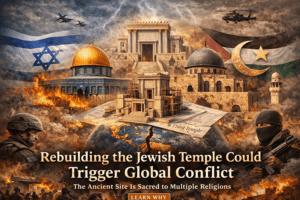
For thousands of years, the ancient city of Jerusalem has stood at the center of the world’s three major monotheistic religions. At the heart of this spiritual crossroads lies the Temple Mount, a small plateau that carries enormous religious meaning for Jews, Christians, and Muslims alike.
In Jewish tradition, this is the site where the First and Second Temples once stood and where some believe a future temple may one day be rebuilt. Christianity connects the site to biblical prophecy and the history of Jesus Christ, while Islam reveres the area as home to the Al-Aqsa Mosque, one of the holiest places in the Muslim world.
Because each faith views this same location through a different theological lens, the Temple Mount has become not only a symbol of spiritual devotion but also one of the most sensitive religious and political sites on Earth. Understanding these differing perspectives helps explain why discussions about rebuilding a temple in Jerusalem resonate far beyond the city itself and can influence global conversations about faith, history, and peace.
The Different Religious Beliefs
1. Judaism (Primary Connection)
-
Many Jews believe a Third Temple will eventually be built in Jerusalem with the coming of the Messiah.
-
It would restore Temple worship and symbolize a period of peace and justice in the world.
2. Christianity
Christian views vary:
-
Some Christians believe a future temple may appear during end-times events before the return of Jesus Christ.
-
Others believe Jesus already fulfilled the role of the Temple and that no new temple is needed.
3. Islam
Islam does not believe in a future Jewish temple and generally opposes rebuilding one at the site because it is home to:
These stand on the area known as the Temple Mount.
Simple summary
| Religion | View of a Third Temple |
|---|---|
| Judaism | Future temple expected with the Messiah |
| Christianity | Some expect it in end-times; others say Jesus fulfilled the temple |
| Islam | Opposes rebuilding because the site is an Islamic holy place |
Judaism, Christianity, and Islam – Side-by-Side Comparison
| Topic | Judaism | Christianity | Islam |
|---|---|---|---|
| God | One God, indivisible | One God expressed as the Trinity (Father, Son, Holy Spirit) | One God (Allah), completely one and without partners |
| Key Founder / Figure | Patriarch Abraham and the covenant with Israel | Centered on Jesus Christ | Final prophet is Muhammad |
| Main Holy Book | Hebrew Bible (Tanakh) | Bible (Old Testament + New Testament) | Qur’an |
| View of Jesus | Not the Messiah or divine | Son of God and Savior | Prophet and messenger of God |
| Messiah | Future human Messiah still expected | Jesus is the Messiah who has already come and will return | Jesus (Isa) will return before the Day of Judgment |
| Place of Worship | Synagogue | Church | Mosque |
| Sacred City | Jerusalem | Jerusalem important to Christian history | Mecca and Jerusalem |
| Temple Mount | Site of the ancient Jewish temples; some expect a future temple | Important biblical site connected to Jesus and prophecy | Home of Al-Aqsa Mosque, one of Islam’s holiest sites |
| Salvation / Judgment | Living according to God’s law and righteousness | Salvation through faith in Jesus and God’s grace | Judgment by God based on faith and deeds |
| Population | ~15–16 million | ~2.3–2.4 billion | ~1.9–2.0 billion |
Christianity’s View of the Temple
Christian theology changed the concept of the Temple after the life of Jesus Christ.
Many Christians believe:
1. Jesus replaced the Temple system
In the New Testament, Jesus is described as fulfilling the role of the Temple.
Christians believe God’s presence is now accessible through Christ rather than through a physical temple building.
2. Believers themselves are “the temple”
The New Testament teaches that God’s Spirit dwells within believers rather than in a specific building.
3. Different Christian interpretations
Christians do not all agree about a future temple:
-
Many churches (Catholic, Orthodox, many Protestants)
Believe the Temple is no longer necessary because Jesus fulfilled its purpose. -
Some Evangelical / prophetic interpretations
Believe a Third Temple may be rebuilt in Jerusalem before the end times, but not as a place where God returns — rather as part of end-time events.
Judaism’s View of Rebuilding the Temple
In traditional Judaism:
-
The Temple is the central place where God’s presence (Shekhinah) dwells among the people of Israel.
-
Many Jews believe that when the Messiah comes, the Temple will be rebuilt in Jerusalem.
-
The rebuilding is associated with:
-
Restoration of proper worship
-
World peace
-
Gathering of Jewish people back to Israel
-
A renewed relationship between God and humanity.
-
Importantly, Jews generally do not say God “returns” because He left, but that His special presence will again dwell visibly among the people in the Temple.
How Islam Views Rebuilding the Jewish Temple
Most Muslims strongly oppose rebuilding a Jewish temple on that site. The main reasons are:
1. The Temple Mount Is Already an Islamic Holy Site
Rebuilding a temple would likely require removing or altering Al-Aqsa Mosque or the Dome of the Rock, which Muslims see as unacceptable.
2. Religious and Political Identity
For Muslims, protecting Al-Aqsa is tied to religious duty and identity, especially for Palestinians.
3. Fear of Losing Control of a Sacred Site
Any attempt to rebuild a temple is widely viewed in the Muslim world as threatening one of Islam’s most sacred places.
Key Difference from Christianity
-
In Christianity, Jesus is both the Messiah and the Judge at the end of time.
-
In Judaism, the Messiah is a future human king who will restore peace — but God Himself remains the only Judge of good and evil.
1. Judaism (Primary Connection)
-
Many Jews believe a Third Temple will eventually be built in Jerusalem with the coming of the Messiah.
-
It would restore Temple worship and symbolize a period of peace and justice in the world.
2. Christianity
Christian views vary:
-
Some Christians believe a future temple may appear during end-times events before the return of Jesus Christ.
-
Others believe Jesus already fulfilled the role of the Temple and that no new temple is needed.
3. Islam
Islam does not believe in a future Jewish temple and generally opposes rebuilding one at the site because it is home to:
-
Dome of the Rock
These stand on the area known as the Temple Mount.
Why Rebuilding the Temple Could Cause Major Consequences
1. Conflict With the Muslim World
The Temple Mount contains Al-Aqsa, which is sacred to about 2 billion Muslims.
Any attempt to remove or alter it would likely be viewed as an attack on Islam.
Many analysts believe it could trigger:
-
Massive protests across Muslim countries
-
Regional wars in the Middle East
-
Violent unrest globally.
2. Regional War Risk
Jerusalem is already central to the Israeli–Palestinian conflict.
Changes to the Temple Mount could involve:
-
Israel
-
Palestinian groups
-
Neighboring states like Jordan, which oversees the Islamic site
-
Other regional powers such as Iran.
3. Global Religious Reaction
Because billions of people follow the three Abrahamic religions:
-
Jews (~15 million)
-
Christians (~2.3 billion)
-
Muslims (~2 billion)
A conflict involving a sacred site for all three could have global religious and political repercussions.
4. End-Times Interpretations
Some religious groups—especially certain Christians—connect events at the Temple Mount with biblical prophecy.
This can sometimes intensify reactions because people see events there as spiritually significant.
Reality Today
The current policy in Jerusalem is called the “status quo”:
-
Muslims pray at Al-Aqsa Mosque.
-
Jews pray at the Western Wall below the mount.
Governments generally try to avoid changing this arrangement because of the risk of conflict.
The Third Temple and The Temple Mount
✅ Simple summary
If a temple were actually built on the Temple Mount today, many experts believe it could cause:
-
Major unrest in the Muslim world
-
Escalation of the Israeli-Palestinian conflict
-
Possible regional war
-
Global political and religious tensions.
That’s why the issue is often considered one of the most sensitive religious flashpoints on Earth.
The Third Temple Prophecy — Why Its Construction Signals the End
Rebuilding the Temple in Jerusalem
Regardless how you look upon the reasoning behind wanting to build the “Third Temple”, it is important to be aware of the controversies and perhaps the global ramifications this may cause. Be aware and be cautious before making any major decisions.
Thank you for reading,
Michael
Comments are always welcome.