Table of Contents
ToggleThe Historical Story of Israel and Palestine
The Romans conquered the biblical Israel
1. Biblical Israel (c. 1050–586 BCE)
1b. Roman Conquest and the Birth of the Name “Palestine.”
2. Ottoman Empire (1517–1917)
3. World War I led to the collapse of the Ottoman Empire.
Britain took control under the Mandate for Palestine.
3b. The Balfour Declaration and British Mandate
4. The political State of “Israel” (1948)
4b. The 1948 War and the Nakba
1. Ancient Roots and Biblical Origins
The land between the Jordan River and the Mediterranean Sea has been home to many peoples for thousands of years.
In Biblical tradition, figures such as Abraham, Isaac, and Jacob form the foundation of the ancient Israelites. Over centuries, the Kingdoms of Israel and Judah rose and fell, leaving a deep cultural and religious legacy in the region.
2. Roman Conquest and the Birth of the Name “Palestine.”
During the first and second centuries CE, the Roman Empire tightened control over Judea.
After major Jewish revolts, Rome crushed the resistance and, in 135 CE, renamed the province “Syria Palaestina.”
This renaming—later shortened to Palestine—was intended to weaken Jewish ties to the region.
Despite this, the land remained ethnically and religiously diverse for centuries, home to Jews, Arabs, Christians, Samaritans, and others.
3. A Land of Empires: Byzantine to Ottoman Rule
From antiquity through the 19th century, the region passed through many hands:
-
The Byzantine Empire
-
Early Arab Caliphates
-
Crusader kingdoms
-
The Mamluk Sultanate
-
The Ottoman Empire (1516–1917)
Throughout these eras, the vast majority of residents were Arabic-speaking Palestinians living in villages, towns, and ancient cities like Jerusalem, Gaza, Hebron, Jaffa, and Haifa.
4. The Rise of Zionism in the Late 1800s
In the late 19th century, a new political movement emerged in Europe: Zionism, calling for the establishment of a Jewish homeland.
Many Jews—facing antisemitism, persecution, and pogroms—saw Palestine as their historic refuge.
At the same time, Palestinians, who formed the demographic majority, feared large-scale immigration would threaten their land, culture, and political rights.
5. The Balfour Declaration and British Mandate
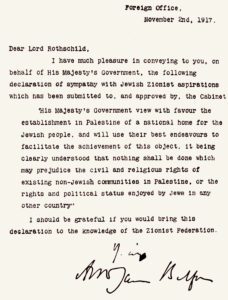
In 1917, during World War I, the British government issued the Balfour Declaration, supporting a “national home for the Jewish people” in Palestine—
without consulting the Arab population already living there.
Under British rule (1917–1948):
-
Jewish immigration increased sharply
-
Land purchases expanded
-
Palestinian resistance grew
-
Violence and tension escalated
This period set the stage for the modern conflict.
Balfour Declaration (Primary Source – UK Government)
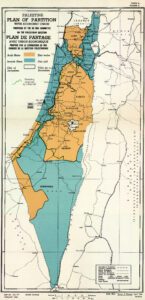
6. The UN Partition Plan of 1947
After decades of conflict under British administration, the United Nations proposed a partition of the land into two states—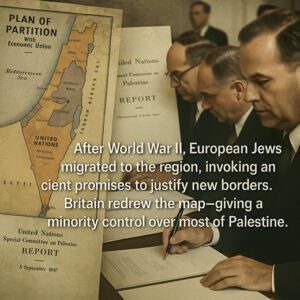
one Jewish and one Arab.
Key points:
-
The map granted about 56% of the land to the Jewish state
-
Jewish communities at that time owned less than 10% of the land
-
Zionist leadership accepted the plan
-
Palestinian and Arab leaders rejected it as unfair
The region plunged into civil conflict between Palestinian Arabs and Zionist militias.
7. The 1948 War and the Nakba 
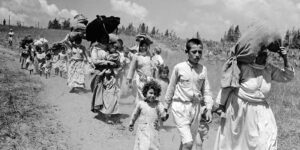
In 1948, Zionist leadership declared the State of Israel.
Neighboring Arab states intervened, and full-scale war broke out.
Consequences of the war:
-
Over 700,000 Palestinians fled or were expelled
-
More than 400 villages were depopulated or destroyed
-
Israel established control over 78% of historic Palestine
-
Palestine was not established as a state
-
Gaza fell under Egyptian rule; the West Bank under Jordanian rule
For Palestinians, this became known as the Nakba—the “catastrophe.”
About the Nakba (United Nations)
👉 Describes the displacement of Palestinians during 1948
8. Decades of War, Occupation, and Failed Peace
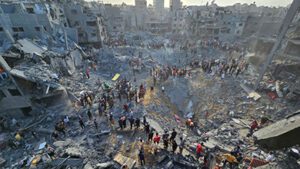
The years that followed saw repeated wars and shifting borders:
-
1956 Suez Crisis
-
1967 Six-Day War (Israel occupied Gaza, the West Bank, and East Jerusalem)
-
1973 Yom Kippur War
-
First and Second Intifadas
-
Failed peace attempts in the 1990s and 2000s
-
Expansion of Israeli settlements in occupied territories
For Palestinians, life has been shaped by displacement, military occupation, restricted movement, and statelessness.
For Israelis, the struggle for security, identity, and survival has defined national politics.
9. A Conflict Without Resolution—Yet
The Israel-Palestine conflict remains one of the world’s most complex and emotionally charged.
Its roots stretch back thousands of years but took their modern form in the early 20th century.
Understanding this history—its peoples, its pain, and its competing narratives—is essential for anyone seeking to understand why peace has been so elusive.
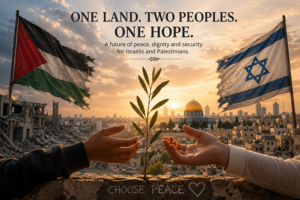
Yet millions around the world still hold hope for a future where both Palestinians and Israelis can live with security, dignity, and self-determination.
Overview
The history of Israel and Palestine is a story shaped by ancient traditions, shifting empires, and modern political struggles. From the Biblical kingdoms of Israel and Judah, through Roman rule and the renaming of the region as Palestine, the land has long been home to diverse communities.
In the late 19th and early 20th centuries, Jewish migration to the region grew through the Zionist movement and British support expressed in the 1917 Balfour Declaration. Rising tensions between Jewish immigrants and the Palestinian Arab majority led to conflict under the British Mandate.
After World War II, the United Nations proposed dividing the land into Jewish and Arab states. The 1948 Arab–Israeli War that followed resulted in the establishment of Israel and the displacement of more than 700,000 Palestinians—an event known as the Nakba.
Decades of war, occupation, failed peace attempts, and shifting borders have followed, leaving both Palestinians and Israelis living with insecurity, loss, and unresolved national aspirations. Understanding this history is essential for understanding why the conflict endures and why the world continues to seek a just and lasting peace for both peoples.
For thousands of years, the land between the Jordan River and the Mediterranean Sea has been shaped by ancient civilizations, empires, faiths, migrations, and conflict. Today’s struggle between Israelis and Palestinians is not the product of a single moment, but the result of centuries of history—biblical origins, Roman conquest, Ottoman rule, Zionist immigration, British promises, partition, war, displacement, and decades of unresolved grievances. To understand the present, we must first understand this long and complex past.
Where People Went After the Roman Conquest
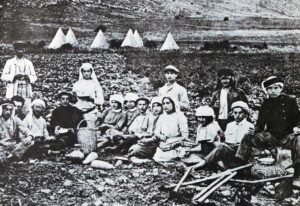
1. Jewish Populations
Roman policies after the revolts were harsh. Many Jews were:
• Killed or enslaved
Tens of thousands were taken as slaves to:
-
Rome (many worked on major construction, including the Colosseum)
-
North Africa (especially Egypt, Cyrenaica, Carthage)
-
Anatolia (modern Turkey)
• Exiled or dispersed
Large Jewish communities formed in:
-
Babylonia (Iraq) — already the biggest Jewish center outside Judea
-
Persia (Iran)
-
Arabian Peninsula
-
Greece
-
Italy
-
Spain (later becoming Sephardic Jews)
-
North Africa
This dispersion became known as the Jewish Diaspora.
Important Clarification:
Not all Jews left. A small Jewish population remained in Palestine continuously for centuries (in Galilee, Jerusalem, Tiberias, Safed, etc.).
2. Non-Jewish Populations
Most non-Jewish inhabitants did not leave. They stayed in the region under Roman rule.
These groups included:
-
Aramaic-speaking locals
-
Greeks
-
Nabateans
-
Samaritans
-
early Christians
-
various Arab tribes
They formed the ancestors of many modern Palestinians, Syrians, Lebanese, and others.
3. Later Arab Migrations
Starting in the 600s CE:
-
Muslim Arab armies arrived
-
Many locals converted rather than left
-
Arabic language spread and replaced earlier languages
-
Population remained mostly the same families, just culturally Arabized
This means modern Palestinians are largely descendants of:
-
ancient local populations,
-
mixed with incoming Arab groups,
not recent migrants replacing them. -
Summary: Where Did People Go After the Roman Conquest?
After Rome crushed the Jewish revolts in 135 CE, the region changed dramatically:
Jewish Population
-
Many were killed, enslaved, or deported to Rome, North Africa, and Anatolia.
-
Large numbers migrated east to Babylonia (Iraq), Persia, Arabia, Greece, and Spain.
-
A small Jewish community remained in Palestine continuously for centuries.
Non-Jewish Population
-
Most stayed in the region under Roman rule.
-
Included Aramaic-speaking locals, Samaritans, Greeks, early Christians, and Arab tribes. Over time, especially after the 600s CE, they adopted Arabic language and culture, becoming the core ancestors of today’s Palestinians. In short: Rome didn’t empty the land — it reshaped it. Jews became a global diaspora, and the long-rooted local population evolved into what we now know as the Palestinian people.
-
Balfour Declaration Partition Plan
Simple Timeline: Israel / Palestine
1. Ancient Times (c. 1000–586 BCE)
- Jewish kingdoms exist in the land (Biblical Israel)
2. 586 BCE – 100s CE
- Conquered by empires (Babylonian, Persian, Roman)
- Jews lose political control and many are dispersed
3. 100s CE – 1800s
- Land ruled by many empires (Romans, Islamic caliphates, Ottomans)
- Mostly Arab population lives there (ancestors of Palestinians)
- Small Jewish communities remain
4. Late 1800s – Early 1900s
- Jews begin returning in larger numbers (Zionism)
- Land still mostly Arab, tensions begin
5. 1917–1947 (British Rule)
- Britain controls the area
At its heart, this conflict is about land—but not just land. It is about what that land means to two peoples. For many Israelis, it represents a long-awaited homeland and a place of safety after generations of persecution. For Palestinians, it is the land where their families have lived for generations, and where many lost homes, roots, and freedom.
Since 1948, both sides have lived with fear, loss, and unresolved pain. The land has become more than territory—it holds memory, identity, and deep emotional ties that cannot simply be divided on a map.
A lasting peace will not come from one side claiming the land over the other, but from recognizing that both peoples belong to it in different ways. The future depends on a difficult but necessary step: seeing each other not as obstacles, but as human beings—each deserving of dignity, security, and a place to call home.
- Both Jews and Arabs claim the land
- Violence and conflict increase
6. 1947–1948 Turning Point
- UN proposes splitting land into two states
- War breaks out
- David Ben-Gurion declares Israel (1948)
7. After 1948
- Israel becomes a country
- Many Palestinians are displaced
- Populations become separated (e.g., West Bank, Gaza Strip)